Pesquisar neste blogue

📌 “Este blog integra o ecossistema: Museu de Filatelia Sérgio Pedro: Estudos, peças raras, maximafi

📌 “Este blog integra o ecossistema: Museu de Filatelia Sérgio Pedro: Estudos, peças raras, maximafilia, marcofilia e história postal.
Mostrar mensagens com a etiqueta 1950. Mostrar todas as mensagens

sábado, 11 de julho de 2026

Quando a filatelia promovia a própria filatelia: a vinheta da III FLAVEX (Porto, 1950)


No universo do colecionismo, existem peças cuja importância não reside na raridade intrínseca, mas na capacidade de documentar a vida associativa e cultural da própria filatelia. A III FLAVEX – Exposição Filatélica Artístico-Humorística, realizada no Porto em 21 de janeiro de 1950, constitui um desses casos.

Recentemente chegaram ao acervo do Museu de Filatelia Sérgio Pedro dois testemunhos diretamente relacionados com este evento: uma vinheta comemorativa e um postal ilustrado circulado. Em conjunto, estas peças permitem observar como a filatelia procurava divulgar-se a si própria numa época em que os clubes, exposições e encontros filatélicos desempenhavam um papel central na formação dos colecionadores.

Uma exposição para celebrar a filatelia

A designação do certame merece atenção:

III FLAVEX – Exposição Filatélica Artístico-Humorística

A combinação dos conceitos filatélica, artística e humorística revela uma iniciativa com uma forte componente cultural e criativa. Embora ainda subsistam questões documentais por esclarecer, a existência de material próprio da exposição demonstra uma organização suficientemente estruturada para produzir peças promocionais específicas.

A vinheta da III FLAVEX

Entre os objetos associados ao evento encontra-se uma interessante vinheta comemorativa impressa em vermelho e preto.

A composição apresenta uma vista estilizada da cidade do Porto, onde podem ser identificados elementos característicos da paisagem urbana, nomeadamente o casario da zona histórica e uma representação da Ponte D. Luís I. A leitura de uma estrutura vertical como possível representação da Torre dos Clérigos permanece, contudo, uma hipótese interpretativa que requer confirmação.

A vinheta inclui a inscrição:

Exposição Filatélica Artístico-Humorística
Porto
Portugal
Terceira FLAVEX
Janeiro MCML

Um dos aspetos mais interessantes da peça é a identificação explícita dos seus responsáveis gráficos:

FLÁVIO INV.
T. M. SERQUEIRA IMP.

As abreviaturas seguem a tradição gráfica latina:

  • invenit (inv.), indicando o autor do desenho;
  • impressit (imp.), identificando o impressor.

Sabemos assim que o desenho foi concebido por Flávio e impresso por T. M. Serqueira, um detalhe pouco frequente em muitas vinhetas filatélicas portuguesas do período.

Quando a vinheta encontra o correio

Ainda mais revelador é o postal ilustrado produzido para a exposição.

Trata-se de um postal promocional da III FLAVEX que inclui o cabeçalho “Arte Humor” e o sugestivo convite:

“Conheça a poesia dos selos”.

O postal reproduz o poema “Pombo-Correio”, de António Correia d'Oliveira, evidenciando a tentativa de aproximar a filatelia da literatura e da cultura popular.

Mas o elemento verdadeiramente notável encontra-se no percurso postal da peça.

O postal foi expedido no Porto em 21 de janeiro de 1950, data coincidente com a realização da exposição, e chegou a Lisboa no dia seguinte, conforme comprova o datador mecânico de 22 de janeiro de 1950.

O percurso documentalmente comprovado é:

Porto (21.01.1950) → Lisboa (22.01.1950)

Uma peça com múltiplas camadas de interesse

O postal reúne vários elementos que, isoladamente, já despertariam interesse:

  • selo da emissão Caravela Portuguesa de 50 centavos;
  • carimbo comemorativo da III FLAVEX;
  • circulação postal efetiva;
  • aplicação de uma vinheta da exposição;
  • obliteração complementar da própria vinheta.

Em conjunto, estes elementos constituem um excelente exemplo de correspondência preparada no contexto de uma exposição filatélica, mas que cumpriu simultaneamente uma função postal real.

Particularmente interessante é a dupla ação obliteradora observável no selo:

  1. aplicação do carimbo comemorativo da exposição;
  2. posterior tratamento por máquina obliteradora em Lisboa.

Esta sequência documenta o percurso efetivo da peça após a sua passagem pelo evento.

Um destinatário de relevo na filatelia portuguesa

O postal foi endereçado ao:

Ex.mo Sr. Brigadeiro José da Cunha Lamas
Estrada de Benfica, 574
Vila Ventura, 1.º D.
Lisboa

A investigação conduzida até ao momento aponta para a identificação do destinatário como o Brigadeiro José da Cunha Lamas (1889–1975), militar, investigador e figura destacada da filatelia portuguesa.

Embora a correspondência entre o destinatário do postal e o filatelista seja altamente plausível, esta identificação deve continuar a ser tratada como hipótese documental em processo de validação, até à reunião de elementos complementares que permitam estabelecer a associação de forma definitiva.

Mais do que simples curiosidades

A vinheta e o postal da III FLAVEX recordam-nos que a história da filatelia não se faz apenas através dos selos emitidos pelos correios.

Faz-se também através de exposições, clubes, encontros, publicações, vinhetas, carimbos comemorativos e toda uma cultura material produzida pelos próprios colecionadores.

Setenta e cinco anos depois, estas peças continuam a cumprir a sua função original: promover a filatelia. A diferença é que hoje já não anunciam uma exposição futura. Documentam um passado que importa preservar, estudar e compreender.

São, afinal, verdadeiros ecos do tempo.


👉 A ficha de catálogo, com a análise técnica e histórica detalhada, encontra-se publicado no Acervo & Ensaio, órgão de estudo do Museu de Filatelia Sérgio Pedro, onde o documento foi integrado no corpus de investigação do museu

sexta-feira, 6 de março de 2026

Maxicard Goethe (1749–1949): Bicentennial and Weimar’s 700th Anniversary


Yt:DD-ZS 53

Stamp: Germany (Soviet Zone), commemorative issue for the 200th anniversary of Johann Wolfgang von Goethe (1749–1949), in sepia/brown tonalities, face value 12 Pfennig. (Issued in 20.07.1949)

Postmark: Special commemorative circular datestamp (Sonderstempel) from Weimar, celebrating "700 JAHRE" (700 years of the city, 1250–1950), dated 1950.

Postcard: Illustrated postcard featuring a printed reproduction of the oil painting Goethe in the Roman Campagna (1787) by Johann Heinrich Wilhelm Tischbein.


Concordance 

Thematic: Excellent thematic concordance. Both the stamp and the postcard honor Johann Wolfgang von Goethe. Tischbein’s painting is the most iconic visual representation of the author, creating a perfect thematic harmony with the bicentenary issue on the stamp.

Geographic: Strong geographic concordance.The stamp originated in the Soviet Occupation Zone (SBZ) and the postmark is from Weimar. Weimar was the center of Goethe’s life and where he produced most of his work, making it the most relevant location for the cancellation of a Goethe-themed item.

Temporal: Good temporal concordance.Although the stamp was issued on 20.07.1949, the 1950 postmark (celebrating the 700th anniversary of Weimar) falls within the valid postal period of the stamp and the extended "Goethe Year" celebrations, complying with maximaphilic requirements.

Maximum Card 200th Birth Anniversary Goethe


Yt:DE-FWH 48

Stamp: Württemberg, commemorative issue Goethe 1749–1949, in blue tonalities, face value 30 Pfennig. (Issued in 12.08.1949)

Postmark: Circular datestamp (CDS) from Frankfurt (Main) dated 31.3.1950.

Postcard: Illustrated postcard dedicated to Johann Wolfgang von Goethe, featuring a printed reproduction of the Gips‑Relief von Angelica Facius (1827). Edition Verlag D.M. C. Köln


Concordance
Thematic: Excellent thematic concordance.
The stamp, the postmark and the postcard all honour Johann Wolfgang von Goethe, one of Germany’s most significant literary figures.

Geographic: Strong geographic concordance.
The stamp originates from Württemberg, and the postmark is from Frankfurt (Main) — Goethe’s birthplace — making it a highly appropriate cancellation location for a Goethe‑themed maximum card.

Temporal: Good temporal concordance.
The cancellation date 31.3.1950 falls within the normal postal period of the 1949 Goethe commemorative issue, complying with maximaphilic temporal requirements.


quinta-feira, 22 de janeiro de 2026

Maximum Card 250 Years Berlin Academy Of Science - Wilhelm von Humboldt


Yt:DD 18

Stamp: Germany – Deutsche Demokratische Republik (DDR) – Commemorative series “250 Years Berlin Academy of Science – Wilhelm von Humboldt”, 8 Pf, carmine‑red, showing an engraved portrait of Wilhelm von Humboldt associated with the tercentenary celebration of the Academy of Sciences in Berlin. (Issue: 10.07.1950)

Postmark: Germany – Commemorative postmark “DEUTSCHE AKADEMIE DER WISSENSCHAFTEN ZU BERLIN – 250 JAHRE” – 09.12.1950
Special cancellation created for the 250th anniversary of the Berlin Academy of Sciences. Its commemorative inscription directly relates to Humboldt’s role in the institution, clearly distinguishing it from a standard circular date stamp.

Postcard: Monochrome printed illustration presenting a classical portrait drawing labelled “WILHELM VON HUMBOLDT – Goethes Freunde. IV.” The depiction follows the traditional academic portrait format associated with early 19th‑century German cultural editions, highlighting Humboldt’s likeness in a detailed half‑length composition. (Edition: unknown)

Concordance:

Thematic: The thematic concordance is outstanding, as all three elements focus on the same historical figure and his scholarly legacy: the stamp honours Wilhelm von Humboldt in connection with the Berlin Academy of Sciences, the postcard presents a portrait of Wilhelm von Humboldt, and the commemorative postmark marks the 250th anniversary of the same institution. Together, these components converge precisely on Humboldt and his academic contributions, forming a perfect triple concordance fully aligned with maximaphily standards.
Geographic: The thematic commemorative stamp, the Berlin Academy anniversary postmark, and the cultural portrait postcard are all connected to Berlin, the city central to Humboldt’s intellectual and institutional activity. This ensures geographic coherence in full accordance with FIP maximaphily guidelines.
Temporal: The postmark date (09.12.1950) occurs within the normal postal validity period of the 1950 commemorative issue, ensuring proper temporal concordance for a maximum card produced during the same year as the stamp’s release.

quarta-feira, 21 de janeiro de 2026

Carte Postale Maximum Raymond Poincaré


Yt:FR 864

Stamp: France – Famous People series – Raymond Poincaré – 15 French francs
(Issue date: 27 May 1950)
Postmark: Paris – Commemorative cancellation for the “Foire de Paris – Philatélie”
(Date present on the cancellation is not readable; based on the Fair’s calendar, the most probable dates of use are 27, 28, or 29 May 1950, the last three days of the event held from 13 to 29 May.)
Postcard: Monochrome printed postcard depicting a portrait of Raymond Poincaré, presented in a formal pose typical of early‑ to mid‑20th‑century French official portraiture. The design frames the statesman with a sober, classical aesthetic that emphasizes his political stature.
The printed caption identifies Raymond Poincaré and his role in French political history.
(Edition not indicated.)

Concordance

Thematic: Full thematic concordance.
The stamp depicts Raymond Poincaré, and the postcard illustrates a portrait of the same historical figure, ensuring complete thematic alignment according to maximaphilic standards. Stamp, postmark, and postcard all relate directly to the same person.
Geographic: Strong geographic concordance.
The stamp is a French issue, the commemorative cancellation was applied in Paris during the Foire de Paris – Philatélie, and the postcard portrays a major figure of French national political history.
All three elements share the same geographic and cultural context.
Temporal: Correct temporal concordance.
The cancellation—although its date is unreadable—is known to have been applied during the Foire de Paris, which ended on 29 May 1950.
Since the stamp was issued on 27 May 1950, the event’s final days (27–29 May) fall within the earliest valid period of postal use of the stamp, satisfying maximaphilic temporal requirements.
Even without a legible date, the context of use confirms that the cancellation aligns with the proper validity period of the issue.

sexta-feira, 16 de janeiro de 2026

Maximum card Birth Centenary of Ruy Barbosa


Stamp: Brazil – commemorative stamp in a carmine‑red tone, face value Cr$ 1.20, belonging to a Birth Centenary of Ruy Barbosa issued in 15.12.1949. The design features an ornate frame, the inscription “BRASIL – CORREIO”, the value expressed in cruzeiros, and an engraved portrait executed in fine linear style, typical of Brazilian postal issues of that period.
Postmark: São Paulo – circular cancellation dated 19 JAN 50, bearing the inscription “A.T.C. COLET.” and “S. PAULO – BRASIL". It is an administrative/routine cancellation, characteristic of collection and sorting services used by the postal system at the time.
Postcard: Beige postcard with monochrome brown printing, depicting portrait of Ruy Barbosa. The paper shows the texture and tonality typical of Brazilian printings from the mid‑20th century. 

Concordance
– Thematic: The commemorative stamp directly represents Ruy Barbosa through an engraved portrait issued for his birth centenary, while the postcard also depicts a portrait of Ruy Barbosa in matching artistic style. This creates perfect thematic alignment, as both stamp and postcard explicitly reference the same historical figure and subject matter.
– Geographic: The São Paulo cancellation corresponds appropriately to the Brazilian origin of both the Ruy Barbosa centenary stamp and the postcard produced in Brazil, ensuring full geographic coherence within the Brazilian postal system.
– Temporal: The cancellation dated 1950 is fully compatible with the period of postal circulation of the Ruy Barbosa centenary issue (late 1940s–early 1950s).
Thus, the temporal relation is coherent: a contemporaneous postcard bearing a portrait of Ruy Barbosa combined with the commemorative centenary stamp used in regular postal circulation.

sexta-feira, 19 de dezembro de 2025

Maximum Card The Capitol, Washington, DC.


Country: USA

Issue: Washington, D.C. Sesquicentennial

Date of Issue: Nov 22, 1950

Postmark: Circular cancel – Washington, D.C. – November 22, 1950

Postcard: Illustration of the U.S. Capitol building with landscaped approach (Edition B. S. Reynolds)

Justification of Maximum Concordance:

The stamp commemorates the sesquicentennial of Washington, D.C. and features the U.S. Capitol, the centerpiece of American government. The postcard illustrates the same landmark with a landscaped approach, reinforcing the subject visually. The cancellation from Washington, D.C., applied on the day of issue, guarantees perfect thematic, geographic, and temporal concordance.


Yvert et Tellier: US 544

terça-feira, 9 de dezembro de 2025

Historical Portraits – Arch of the Viceroys (Arco dos Vice-Reis), Goa (1950)


Country: Portuguese India

Issue: Historical Portraits – Arch of the Viceroys (Arco dos Vice-Reis), Goa

Date of Issue: 1946

Postmark: Circular Date Stamp (CDS) – Goa – 14.1.50

Postcard: Monochrome photographic illustration of the Arch of the Viceroys, an iconic historical gateway in Goa, surrounded by palm trees, captioned with the image of the monument.

Justification of Maximum Concordance:

This maximum card features the Arch of the Viceroys in Goa, a significant historical and architectural landmark built to commemorate the arrival of viceroys during the colonial period. The stamp, issued in 1946, depicts the same monument, reinforcing thematic unity between the philatelic and pictorial elements. The postmark is a CDS from Goa, applied on 14 January 1950, which corresponds to the location of the depicted building and the subject of the stamp. Together, the stamp, the postcard image, and the cancellation achieve maximum concordance by uniting subject, location, and historical context in a single philatelic piece.

Yvert & Tellier: PT-IN 402
Afinsa-Mundifil: PT-IN 380

sexta-feira, 25 de julho de 2025

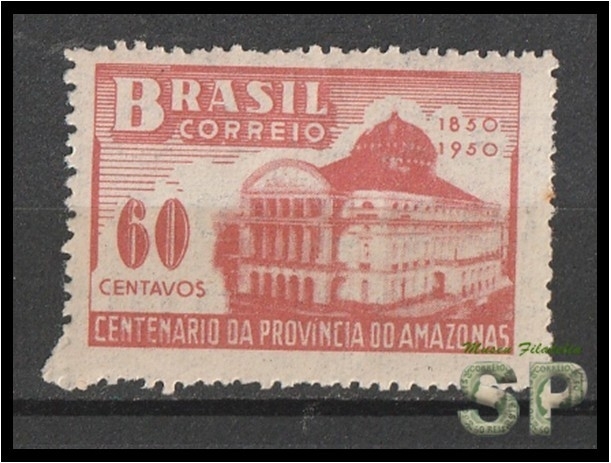
1950 - 100 anos da criação da Província do Amazonas


Este selo celebra os 100 anos da criação da Província do Amazonas, uma data de grande relevância histórica para o Brasil, especialmente no contexto da expansão territorial e administrativa do Império. A emissão destaca o papel da região amazónica na formação nacional.

🧠 2. Conhecimento e Pesquisa (até 35 pontos)

  • País: Brasil
  • Ano de emissão: 1950
  • Valor facial: 60 centavos
  • Tema: Centenário da Província do Amazonas
  • Imagem: Provavelmente o Teatro Amazonas, ícone arquitetónico de Manaus
  • Inscrições: “BRASIL CORREIO”, “1850 1950”, “60 CENTAVOS”, “CENTENÁRIO DA PROVÍNCIA DO AMAZONAS”